WhatsApp for Fintech: Secure Onboarding, KYC Nudges, and Transaction Alerts
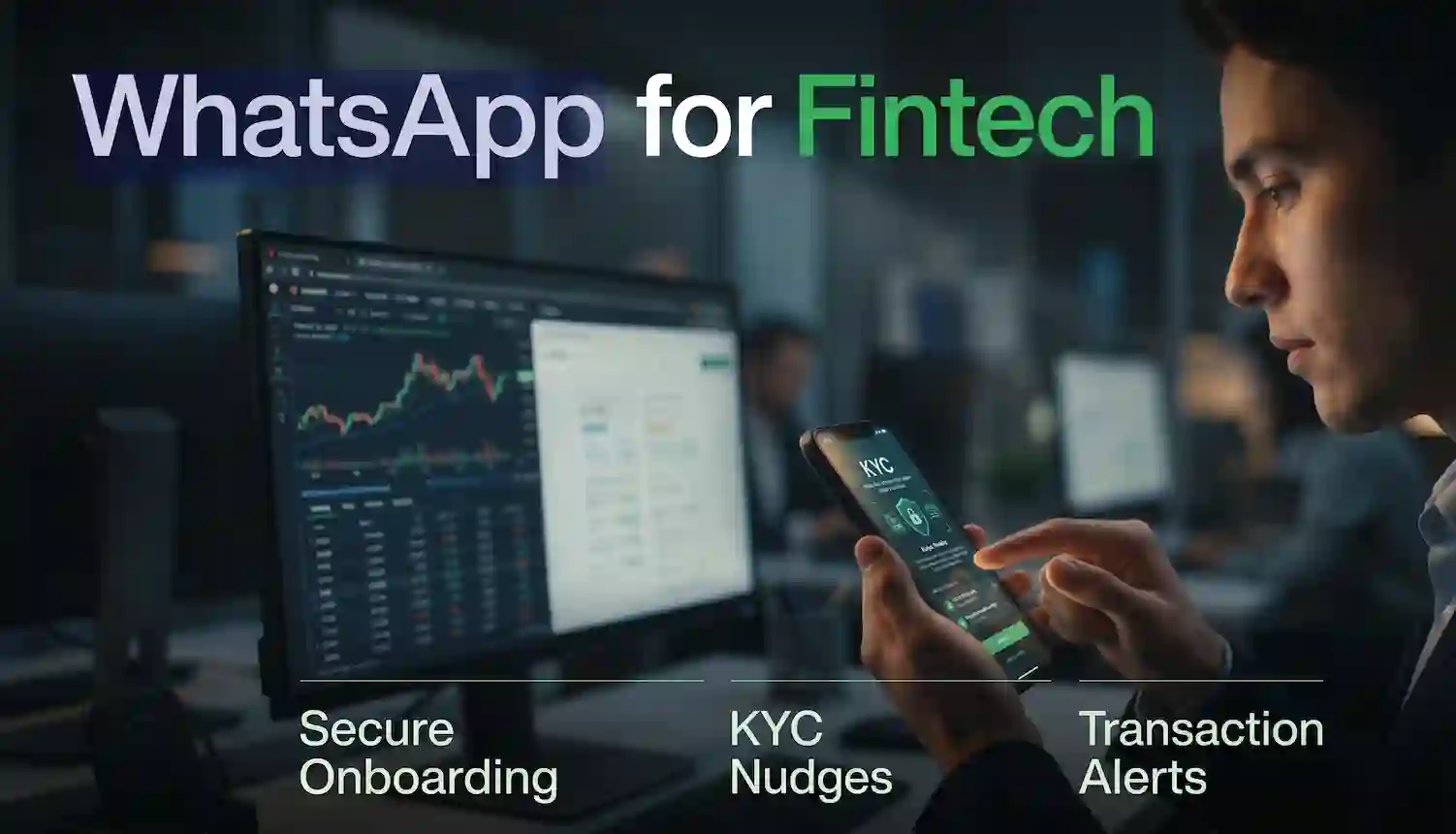
Fintech companies operate in one of the highest-stakes communication environments imaginable. A delayed fraud alert can cost a customer thousands. A confusing KYC step can kill a sign-up before it completes. A slow support response can push a user to a competitor within minutes. WhatsApp, with its 90-plus percent open rates and near-instant read times, is quietly becoming the infrastructure layer that solves all three problems at once. This guide walks through how fintech teams are using WhatsApp for customer onboarding, KYC automation, transaction alerts, and compliant messaging workflows.
The Fintech Case for Conversational Messaging
Traditional fintech communication stacks lean heavily on email and SMS. Email open rates in financial services hover around 20 to 25 percent. SMS gets opened more often but carries no threading, no rich media, and no two-way conversation capability. The result is a disconnected experience where customers receive a welcome email, a separate KYC email, an SMS OTP, and then nothing until something goes wrong.
WhatsApp collapses that fragmentation into a single, familiar thread. Users do not need to download a new app, remember a portal password, or switch between channels. Every interaction, from account creation to a suspicious transaction flag, lives in one place they already check dozens of times a day.
For fintech specifically, the channel advantages are tangible:
- Message delivery confirmation gives compliance teams an auditable record of customer notifications.
- End-to-end encryption satisfies baseline data-in-transit requirements for many regulatory frameworks.
- Two-way messaging allows customers to confirm, dispute, or escalate directly without calling a support line.
- Rich media support lets companies send formatted statements, verification checklists, and onboarding guides inside the chat.
The WhatsApp Business API, accessed through a Meta-approved Business Solution Provider, is the right infrastructure for any fintech operating at scale. It supports template-based messaging for regulated notifications, webhook-driven automation, and CRM integration.
Onboarding and KYC Flows on WhatsApp
Fintech onboarding drops off at every step that adds friction. Research across neobanks and lending platforms consistently shows the biggest abandonment spikes happen during document upload and identity verification. WhatsApp for fintech customer onboarding reduces that friction by meeting users inside the channel where they are already comfortable sharing photos and documents.
A Typical WhatsApp Onboarding Flow
A well-designed onboarding sequence on WhatsApp follows a simple pattern:
- The user signs up on the web or app and opts in to WhatsApp communications.
- A welcome message arrives immediately with a clear next-step prompt, such as “Complete your KYC to activate your account.”
- The chatbot guides the user through document upload, one step at a time, with plain-language instructions.
- If the user drops off, an automated KYC nudge is sent after a defined interval, reminding them of the pending step without being aggressive.
- Once verification is complete, a confirmation message arrives with account details and a prompt to fund the account or explore features.
KYC WhatsApp automation works because the flow is conversational rather than form-based. Instead of presenting a long document upload page, the chatbot asks one question at a time. “Please send a photo of the front of your government ID.” Then: “Now the back.” Each message is a small commitment, which is psychologically easier to complete than a multi-field form.
KYC Nudge Sequences
Not every user completes KYC in one session. A structured nudge sequence typically includes:
- A first reminder 24 hours after the initial drop-off, offering help if the user is stuck.
- A second message at 72 hours that adds urgency by noting the account will remain inactive until verification is done.
- A final message at day seven that offers a direct link to an agent for assisted verification.
This sequence, when built with opt-in compliance and a clear opt-out mechanism, recovers a significant portion of incomplete applications without requiring manual outreach from a sales team.
Transaction Alerts and Fraud Notifications
Fintech transaction alerts on WhatsApp serve two purposes: they reassure customers that their money is moving correctly, and they create the fastest possible detection loop for fraudulent activity.
Real-Time Transaction Confirmations
A fintech transaction alert sent via WhatsApp can include the merchant name, amount, timestamp, and remaining balance in a single formatted message. Because WhatsApp messages appear on the lock screen instantly, the customer sees the alert within seconds of a transaction clearing. Compare that to an email that might sit unread for hours.
Template messages used for transaction alerts must be pre-approved by Meta. A well-structured alert template looks something like this:
“Hi [Name], a payment of [Amount] to [Merchant] was processed at [Time]. Your available balance is [Balance]. If you did not authorize this, reply DISPUTE to raise a case.”
That last sentence is what makes WhatsApp different from SMS. The customer can reply directly. The chatbot captures the DISPUTE keyword, logs the case in the CRM, and either triggers an automated freeze workflow or routes the conversation to a fraud specialist.
Fraud Alerts and Step-Up Authentication
High-value or unusual transactions can trigger a step-up flow. The customer receives an alert asking them to confirm a transaction before it processes. A simple Yes or No reply determines whether the payment proceeds. This kind of real-time, two-way fraud prevention is impossible with email and impractical with phone calls at scale.
Security and Regulatory Guardrails
Security is non-negotiable in fintech, and any WhatsApp implementation must address it directly.
Data Handling and Encryption
WhatsApp Business API messages are encrypted in transit. However, fintech teams must ensure that any data stored by their Business Solution Provider or CRM platform meets the data residency and retention requirements of their operating jurisdiction. This means choosing a provider that offers clear data processing agreements and regional data storage options where required.
Opt-In and Consent Management
Meta requires explicit opt-in before any business can send proactive messages to a user. For fintech, this typically means capturing consent during account registration with a clear disclosure that the user will receive transaction alerts, KYC prompts, and support messages via WhatsApp. Consent records should be stored with timestamps for compliance audit purposes.
Template Governance
All outbound fintech messages that are not replies to user-initiated conversations must use pre-approved Meta templates. Fintech customer support messaging on WhatsApp is exempt from this rule within the 24-hour customer service window, but proactive alerts always require a template. Building a template library with legal and compliance review baked into the approval process prevents costly delays when a new alert type needs to launch quickly.
Sensitive Data in Messages
Full account numbers, card numbers, and passwords should never appear in a WhatsApp message. Alerts should use masked formats, such as a card ending in 4321, and link back to secure in-app views for full details when necessary.
Implementation Roadmap
Rolling out WhatsApp for a fintech product does not need to happen all at once. A phased approach reduces risk and builds internal confidence before scaling.
Phase 1: Transaction Alerts (Weeks 1 to 4)
Start with outbound transaction alerts. These are low-risk, high-value, and immediately visible to customers. Connect your core banking or payment system to the WhatsApp API via webhook, build and get approval for two to three alert templates, and launch to a pilot segment of opted-in users. Measure delivery rates and opt-out rates closely.
Phase 2: KYC Automation (Weeks 5 to 10)
Once the alert infrastructure is stable, layer in the KYC flow. Map the existing onboarding drop-off points, design a chatbot sequence that addresses each one, and A/B test nudge timing. Connect the bot to your KYC vendor’s API so document status updates flow automatically back into the WhatsApp thread.
Phase 3: Support Deflection and Escalation (Weeks 11 to 16)
Enable inbound fintech customer support messaging by building a chatbot that handles common queries, including balance inquiries, transaction history requests, and limit adjustments. Route unresolved conversations to live agents within the same WhatsApp thread so context is never lost.
Phase 4: Proactive Engagement
Once the foundational flows are running, explore proactive engagement such as credit limit increase offers, investment opportunity nudges, or repayment reminders for lending products. Each of these requires fresh template approvals and careful opt-in segmentation, but they represent significant revenue opportunities on a channel where customers are already engaged.
Conclusion
WhatsApp is not a marketing add-on for fintech. It is a core infrastructure decision that affects onboarding completion rates, fraud response speed, and customer support costs. By building compliant KYC automation, real-time transaction alerts, and a structured support escalation path on WhatsApp, fintech companies create a communication experience that is faster, more personal, and more secure than the email-and-SMS stack they are replacing. The companies moving early on this channel are seeing measurable gains in activation rates and customer retention. The ones waiting are handing those gains to competitors.
संबंधित लेख



या धोरणांना कृतीत आणण्यास तयार आहात?
विनामूल्य प्रारंभ करा - 14 दिवस